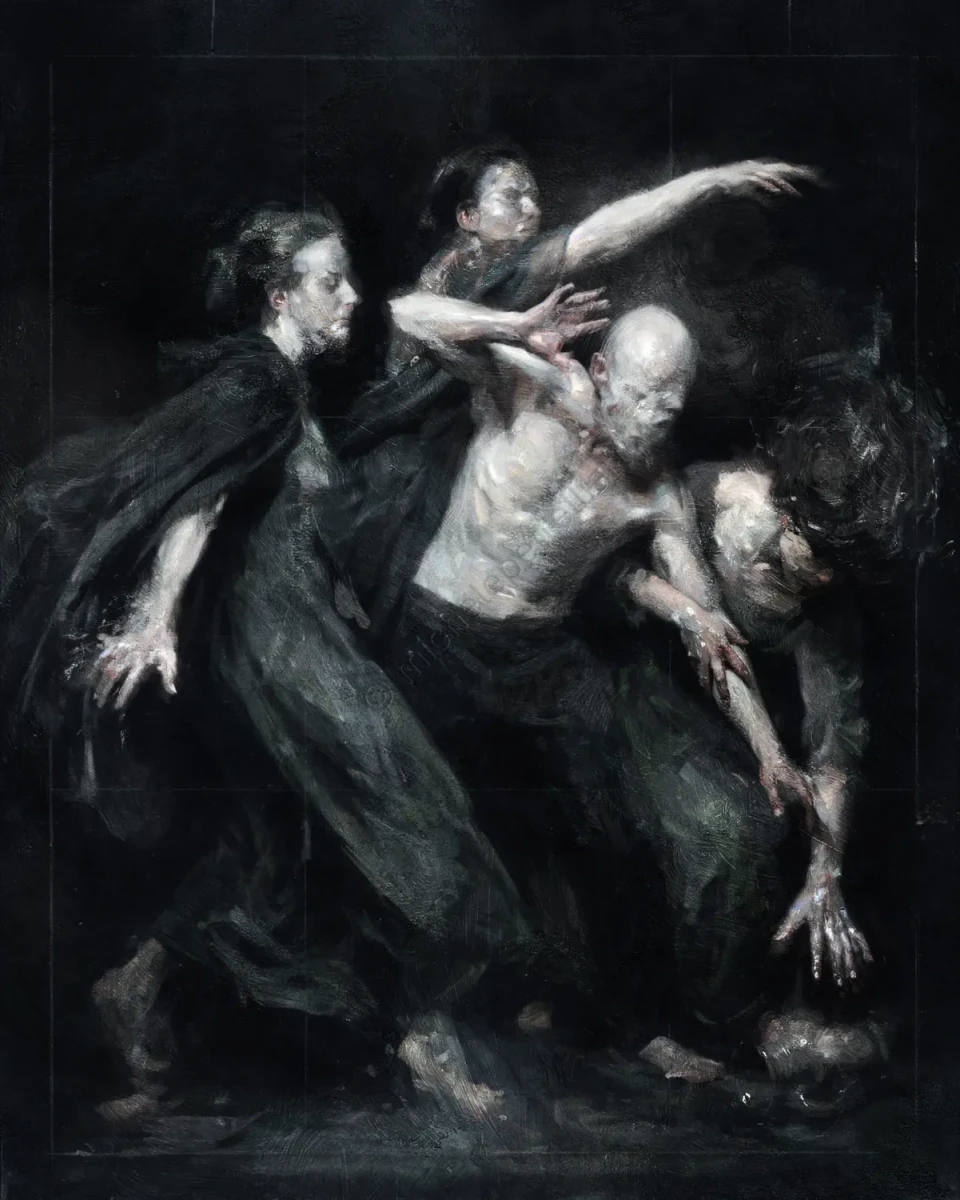
4226 Gehenna
The painting is a somber and tactile vision, where four figures struggle to emerge from an obscurity that envelops them like a second skin. Three women, in heavy and shapeless garments reminiscent of the rural poverty of bygone eras, huddle around a naked, bent man whose pale back is the sole point of light in a sea of shadows.
One of the women, on the left, does not touch the man; she does not dirty her hands. Her presence is a continuous, silently induced judgment that dictates a calculated condemnation. She stands isolated from the violent actions of the others.
The other two women, on the right, are the architects of the fall. With clumsy and desperate gestures, they seize and drag the man, whose form is a tangle of weary and surrendered limbs. One woman, standing with a face marked by toil and determination, pushes him downward, looming over him with her body. The other, crouched, grips him by an arm, joining her strength to that of her companion in an implacable action.
Their clothes are grey and worn, as if woven from the very earth that is devouring them. Their faces are a reflection of despair and blindness. They do not realize that the abyss into which they are dragging the man is already engulfing their own figures. Their action is an endless inertia, a vicious circle in which everyone is both victim and executioner, destined to sink together into oblivion. The darkness is their prison, but it is also their refuge, the only path they know.
One of the women, on the left, does not touch the man; she does not dirty her hands. Her presence is a continuous, silently induced judgment that dictates a calculated condemnation. She stands isolated from the violent actions of the others.
The other two women, on the right, are the architects of the fall. With clumsy and desperate gestures, they seize and drag the man, whose form is a tangle of weary and surrendered limbs. One woman, standing with a face marked by toil and determination, pushes him downward, looming over him with her body. The other, crouched, grips him by an arm, joining her strength to that of her companion in an implacable action.
Their clothes are grey and worn, as if woven from the very earth that is devouring them. Their faces are a reflection of despair and blindness. They do not realize that the abyss into which they are dragging the man is already engulfing their own figures. Their action is an endless inertia, a vicious circle in which everyone is both victim and executioner, destined to sink together into oblivion. The darkness is their prison, but it is also their refuge, the only path they know.
This license does not allow you to modify or use these images for commercial purposes.
You are allowed to share them only by clearly crediting and tagging the author.